Showing posts with label WaterWorks Nature Reserve. Show all posts

Sunday, 5 January 2020

Third Time Lucky?


In 2013 the rangers of Hackney Parks and Green Spaces pollarded a tree in which had a Little Owl occupying one of its hollow branches. The Little Owl could be regularly viewed from the WaterWorks NR Pitch & Putt.


A year 2 child’s dad (in the class I was teaching at the time) worked for HPGS and after I had mentioned what had happened, HPGS had me design a nest box which they put it up in the pollarded tree. 


The nest box was mostly occupied by squirrels and stock doves for 6 years. But yesterday, Eugene Dillon-Hooper tweeted (with photos https://tinyurl.com/rzmx9fj ) that he had spotted a Little Owl on the platform of the nest box. Eugene later confirmed that Mike Messenger spotted the Little Owl earlier on New Years Day.

Fantastic and well done Mike and Eugene!


I paid a visit to the WaterWorks NR today and after a bit of searching the nest box tree (whilst 3 Treecreepers creeped, sang and called around the trees near me), a Little Owl was found in the pollarded tree to the left of the nest box tree. It called several times. The HPGS nest box was placed facing south. However, the original branch and its hole in which a Little Owl used to look out of, faced north. And today, a Little Owl was in a natural tree hollow, facing north. Maybe it doesn’t like the box or prefers facing north or is keeping an eye on the banks of the old river lee for small mammals?

On the same Feb 2013 day, before watching my last WaterWorks NR Little Owl, I also had a Bittern in the WaterWorks NR: https://archive.is/cn2m9

Fingers crossed!

PS. A Little Owl tree had also been pollarded on the Walthamstow Marshes SSSI paddocks a few years prior to the WaterWorks NR pollarding. Lets hope at a third time of asking, a Little Owl can get a few good years of solid me time in its desired tree (however, there are a lot more parakeets around the waterworks these days and a 'doggy beach swimming club' very near the Little Owl tree: https://tinyurl.com/yx78u74l).

Pics, Vidz and eBird links from today:

Little Owl

Treecreeper

WaterWorks NR eBird numbers: https://ebird.org/checklist/S63035716

Graham

Thursday, 7 March 2019

Jan & Feb on Walthamstow Marshes SSSI and the WaterWorks NR

January and February saw Walthamstow Marshes SSSI and the WaterWorks NR add 6 new birds to the Walthamstow patch year list.

On the 2nd of January three Lesser Redpoll were roaming the waterworks.

A Firecrest was seen near the raptor view point bench of the marshes on the 7th of January.

A Red Kite made its way over the waterworks on Jan the 8th.

On the 11th of Feb a Nuthatch was seen and heard from the bridge near the horseshoe thicket of the marshes.

A Siskin went north over the marshes on the 25th of Feb.

A Woodcock was flushed from the horseshoe thicket of the marshes - also on the 25th of Feb.

Other sightings of note were:

7 Redwings and 2 Fieldfares on the marshes
3 Stonechats on the marshes and 1 on the waterworks
2 Jackdaws on the houses by the marshes
2 Water Rails in bed 18 and 13 of waterworks
2 Shovelers on the waterworks

Wednesday, 2 January 2019

2nd January 2019

 Walthamstow Marshes SSSI & WaterWorks NR

50 species combined

Male and Female Stonechat on marshes boardwalk.

ebird numbers for Marshes:


Goldcrest in Horseshoe Thicket

ebird numbers for WaterWorks:


Shoveler in WaterWorks

Sunday, 30 December 2018

The Patch on eBird (& Why do so few birders use eBird?)

Why do so few birders use eBird?

What is eBird?

eBird is the world’s largest biodiversity-related citizen science project, with more than 100 million bird sightings contributed each year by eBirders around the world.


With a few minutes spent on the mobile phone app, birders can record their sightings and their data would contribute to this. Many birders spend time blogging or tweeting about their latest escapades in the field, so why not put the sightings to conservation use on eBird?

Walthamstow on eBird


eBird is a useful tool.

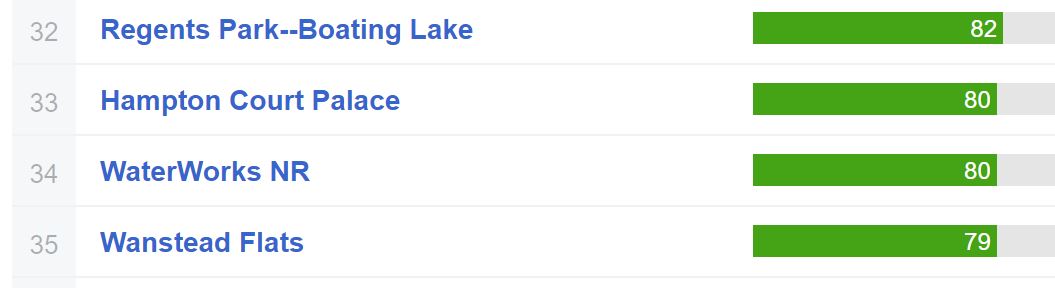
To give eBird a patch watching context, Walthamstow Reservoirs is the 3rd top London ‘Hotspot’ for number of species recorded and Walthamstow Marshes is the 9th.


The WaterWorks NR appears in the top 30 under the guise of ‘Leyton Marsh & WaterWorks.’ But then Leyton Marsh is part of Walthamstow Marshes, so that’s a bit messy. The WaterWorks NR itself comes in at London number 34:


Bird blogging or tweeting, at its best, informs another birder or wildlife enthusiast of wildlife news or shares where and when to view wildlife; at its worst, it is someone’s holiday photos or latest tick (somewhere in between does a bird blog or tweet lay).

With eBird, there is no question of its usefulness. An eBird report can contribute to graphs, data and trends for the patchworker or conservationist. For example:

January to December Observations of Waterfowl on Walthamstow Marshes 1900 - 2018


Northern Wheatear Observations on Walthamstow Marshes 1900 - 2018


This is a link to London's eBird data (find your patch from here):


So, why do so few birders use eBird?


Thursday, 9 August 2018

Nuthatch and other significant Walthamstow patching.

A patch Nuthatch is rare.


June 26th, meters away from the patch, I heard a Nuthatch call above me in the Springfield Park tree I was under. I used the sound clips on the Collins Bird Guide mobile phone app to lure the bird closer to the patch. I crossed the Horseshoe Bridge and on setting foot on the patch, I heard the Nuthatch and then watched it fly over me into the Horseshoe Thicket. Well and truly patch ticked. I heard it again the next day.


The patch stats have Nuthatch with only one other record since 2010:


And it seems that it may have been there since June, as Stuart F heard it again from the patch on August 5th. So, on August 7th, I went back onto the patch for a bit of a twitch. After half an hour of listening on the Horseshoe Bridge, I heard the Nuthatch. I located its tree in my scope and got some views of it, before some Goldfinches moved it off. 

Like everywhere else, the patch is dry and hot. Bed 18 at the WaterWorks is at the lowest I’ve ever seen it; the Marshes are yellow and the Lockwood Reservoir is low. Even a pit stop in the East Warwick hide was hotter on the inside than on the outside!


There was no real sign of any occupation of the newly installed owl boxes on the Marshes.


On the WaterWorks, a Jersey Tiger moth was great to observe. As were a Holly Blue, a Common Blue and a Green-veined White butterfly.

Holly
Common Blue
Green-veined White


Peregrine Falcons are very vocal at this time of year. They can be seen and heard from the Marshes, WaterWorks and the Reservoirs.


Munching on a Parakeet


Common Terns have bred again on the Reservoirs this year, with two chicks. This year their old digs have been replaced with new accommodation courtesy of the LWT.


Familiarity breeds contempt is the phrase that comes to mind when contemplating our Common Sandpipers. When they’re the only wader after a long walk around the Lockwood Reservoir, it’s like they’re rubbing it in; but when they’re not there at all, you miss them.


I often like to torture myself with a big patch day. This usually involves an early rise followed by a 6 hour flogging of the patch from bottom to top, hoping for a treat, but ultimately yielding little or no reward. Lovely. And indeed, if it weren’t for the 15 Mistle/Song Thrush combo right at the start of the day on the ex pitch and putt field or for the Lockwood Dunlin right at the other end of the day, I might have thought it a waste of time. Maybe I should cut this habit out during mid summer.


On July 25th and 27th, two Little Ringed Plovers were welcome visitors to the Lockwood.


Reed Warblers have done extremely well this year. I have never heard and seen them in such numbers across the Marshes and Reservoirs.

@suzehu


Returning back to the WaterWorks:

Sue Huckle (@suzehu) has been patching the WaterWorks like a monster! She and fellow patcher, Mark D observed and recorded the breeding Garden Warbler, Sparrowhawk and Muntjac Deer. The pleasure she draws from watching the natural world is so evident in her images. 

All of the following are Sue’s pics from the WaterWorks Nature Reserve:


The Violet Black-legged Robberfly – a first for the WaterWorks (so probably the patch).

Grass Snake

Garden Warbler

Grey Wagtail -bred in the well head for the 3rd year.

Banded Demoiselle
Smooth Newts
Weasel
Muntjac
Breeding Sparrowhawk pics:


@suzehu 
@grahamhowie

 Walthamstow Birders

Reservoir Logs - Summer 2026 round up

                                                                                    The odd couple  of Sanderling and Ringed Plover  @chris-...